
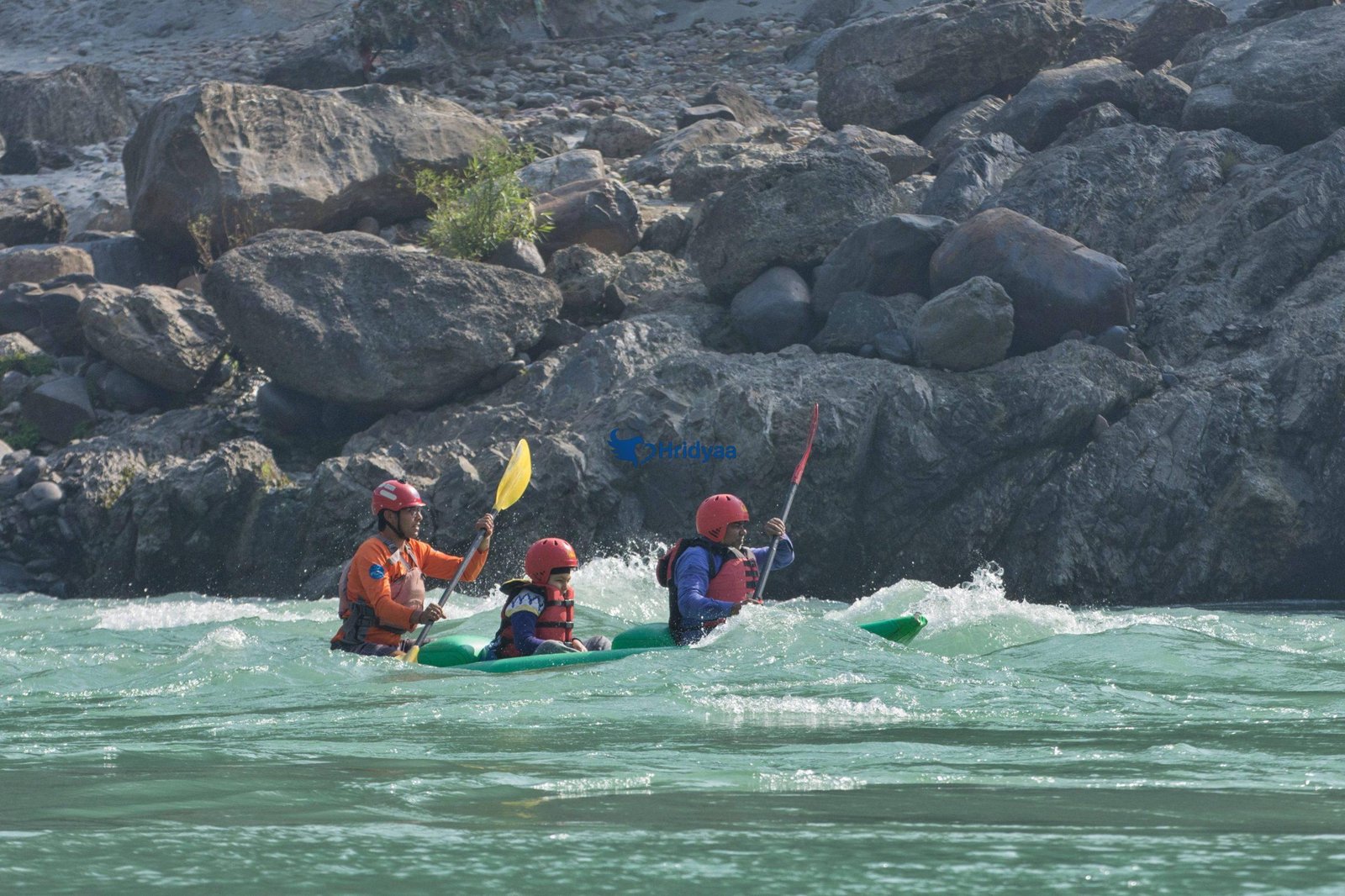
Kayaking in Rishikesh is often overshadowed by rafting, yet it represents one of the most technically demanding and authentic river activities in the region. Unlike rafting, which is group-based and guided, kayaking places the paddler alone with the Ganga, requiring skill, balance, and deep respect for river dynamics. In Rishikesh, kayaking is not a casual tourist thrill but a serious water sport practiced under controlled conditions by trained instructors and committed learners.
Why Rishikesh Is Important for Kayaking
Rishikesh is considered one of India’s primary white-water kayaking destinations due to the gradient, flow consistency, and technical rapids of the Ganga. The river here transitions from glacial-fed mountain water to wider plains, creating ideal stretches for learning, practicing, and advancing kayaking skills. Unlike seasonal rivers elsewhere, the Ganga offers predictable current patterns during much of the year, making Rishikesh suitable for structured kayak training rather than one-off experiences.
Where Kayaking Happens in Rishikesh
Most kayaking activity takes place upstream of the main town, particularly around Shivpuri, Marine Drive, and select stretches between Kaudiyala and Rishikesh. These zones are chosen based on water flow, safety access, and rapid classification. Kayaking is never conducted in crowded ghat areas. Instead, it happens in controlled river sections away from mass tourism, often early in the morning when water release levels are stable.
Kayaking vs Rafting: Understanding the Difference
Many travelers confuse kayaking with rafting, but the two experiences are fundamentally different. Rafting is a guided group activity focused on enjoyment and teamwork. Kayaking is an individual discipline that requires paddling technique, river reading, and self-rescue awareness. In kayaking, the paddler controls direction, balance, and speed entirely on their own. This is why kayaking in Rishikesh is offered primarily as training or skill-based sessions rather than quick tourist rides.
Who Kayaking in Rishikesh Is For
Kayaking in Rishikesh is suitable for physically fit individuals who are comfortable in water and willing to learn technique patiently. Beginners can start with flat-water or gentle current training, while intermediate paddlers work on eddy turns, ferrying, and rolling. This activity is not recommended for non-swimmers, people seeking passive adventure, or those with no interest in learning fundamentals. Mental focus matters as much as physical strength.
Best Time for Kayaking in Rishikesh and Seasonal Reality
The best time for kayaking in Rishikesh is from October to April, when water levels are controlled and visibility is high.
- October to February: Ideal flow, cooler weather, best for learning
- March to April: Slightly stronger current, suitable for intermediate paddlers
- May to June: Higher water release, advanced-level conditions
- July to September (monsoon season): Kayaking suspended due to safety risks
During monsoon months, unpredictable currents and debris make kayaking unsafe even for experts.
How Kayaking Sessions Are Conducted
Kayaking sessions in Rishikesh are conducted by certified instructors, often spread across multiple days. Training begins on calm water, focusing on posture, paddle control, and balance. Gradually, paddlers move into current, learning river entry, exit, and maneuvering techniques. Safety kayakers and rescue protocols are always in place. Helmets, spray decks, buoyancy aids, and river kayaks are provided as part of the session.
Safety Standards and River Awareness
Safety in kayaking depends on understanding the river rather than fighting it. Participants are trained to read currents, identify hazards, and respect seasonal water release patterns. Helmets and life jackets are mandatory at all times. Kayaking without professional supervision in Rishikesh is strongly discouraged due to hidden rocks, cold water shock, and fast-changing flow conditions.
What Travelers Often Get Wrong
A common misconception is assuming kayaking is an upgraded version of rafting. In reality, it is slower to learn and physically demanding. Some travelers also expect instant access to rapids on the first day, which is unsafe and unrealistic. Others underestimate the cold temperature of the Ganga, which affects endurance and reaction time. Kayaking rewards patience, not impatience.
What to Expect When You Actually Go Kayaking
The experience is intense but quiet. There is no shouting, no group energy, and no rush. Most of the time is spent practicing small movements repeatedly. Falling into the river is part of learning, and controlled capsizing is often practiced for safety training. Progress feels gradual, but confidence builds steadily. The river teaches discipline more than thrill.
Environmental Responsibility and Ethics
Kayaking in Rishikesh operates within a sensitive river ecosystem. Ethical operators avoid overcrowding stretches, respect wildlife movement, and follow leave-no-trace principles. Fuel boats and motorized support are avoided. This low-impact approach is why kayaking remains niche but sustainable compared to mass rafting operations.
Final Take: Is Kayaking in Rishikesh Worth It?
Kayaking in Rishikesh is worth it for travelers who want skill-based adventure and personal growth rather than packaged excitement. It demands effort, humility, and time, but offers deep connection with the Ganga. While it may not suit casual tourists, for those willing to learn, Rishikesh provides one of the most respected river kayaking environments in India.


Join The Discussion